Introduction
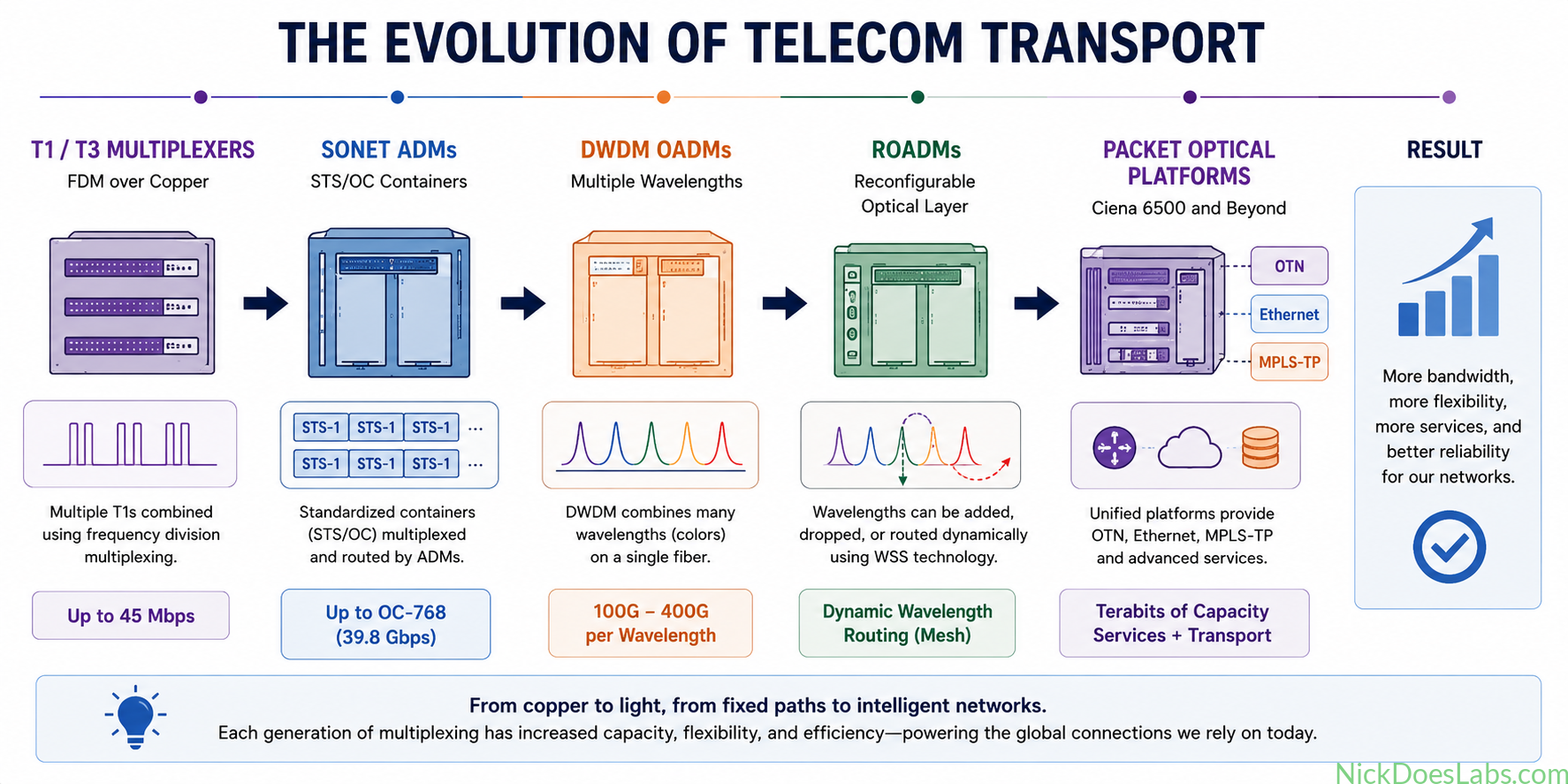
In this article we will be discussing optical multiplexers. Optical multiplexers were the successor to lower-bandwidth copper based T1 and T3 multiplexers. I discuss T-Carrier and FDM multiplexers in this previous article: How Telecom Multiplexers Work: From FDM to T1 and T3.
What is SONET/SDH?
SONET stands for Synchronous Optical Networking. It is also known as Synchronous Digital Hierarchy (SDH). SDH is the international parent standard whereas SONET is the North American implementation. SONET is an optical transport protocol which defines a hierarchy of data transmission signals. These signals have standardized bandwidths ranging from 51.84 Mbps (OC-1) to 39.813 Gbps (OC-768).
SONET Containers and Bandwidths
| SONET Designation | Bandwidth |
|---|---|
| STS-1 / OC-1 | 51.84 Mbps |
| STS-3 / OC-3 | 155.52 Mbps |
| STS-12 / OC-12 | 622.08 Mbps |
| STS-48 / OC-48 | 2.488 Gbps |
| STS-192 / OC-192 | 9.952 Gbps |
| STS-768 / OC-768 | 39.808 Gbps |
SONET STS vs OC Definition
Synchronous Transport Signal (STS) and Optical Carrier (OC) are both terms used to describe levels in the SONET hierarchy. They can refer to the same data stream and there is no bandwidth difference between them. For example an STS-1 is the same bandwidth as an OC-1. The difference is in the physical media that the signal is on. When the signal is on fiber we refer to it as an OC- signal. When it is and electrical signal (inside the Multiplexer) we refer to it as a STS- signal.
What is an STS/OC?
An STS/OC is essentially a channel or container for data. SONET containers were designed to be multiplexed into larger channels for transport within a carrier network. For example think of an envelope (snail mail) as an STS-1. You drop it in a mailbox that you share with two other people (STS-3). The contents of the mailbox are sent on a truck along with four other mailboxes (STS-12) to a sorting facility (multiplexer). At the sorting facility it is sorted onto a different truck (STS-12) that is going towards the destination address. That truck then drops the envelope in the recipients mailbox (STS-3) and the recipient opens the envelope (STS-1) and gets the data inside.
The real power of SONET comes from these “sorting facilities” which is an analogy for Add Drop Multiplexers (ADM).
What are Add Drop Multiplexers?
An Add Drop Multiplexer is a device which is responsible for adding and dropping STS containers to/from higher level containers. For example, an ADM may receive 12 OC-1/STS-1 circuits and bundle them into an OC-12. This OC-12 could run between cities or states to the destination. The ADM closest to the destination can demultiplex the OC-12s back into OC-1s where they can be cross-connected to their destinations.
This is a bit oversimplified because ADMs can do a lot more than this. Let’s dig a bit further than that.
How Do Add Drop Multiplexers Work?
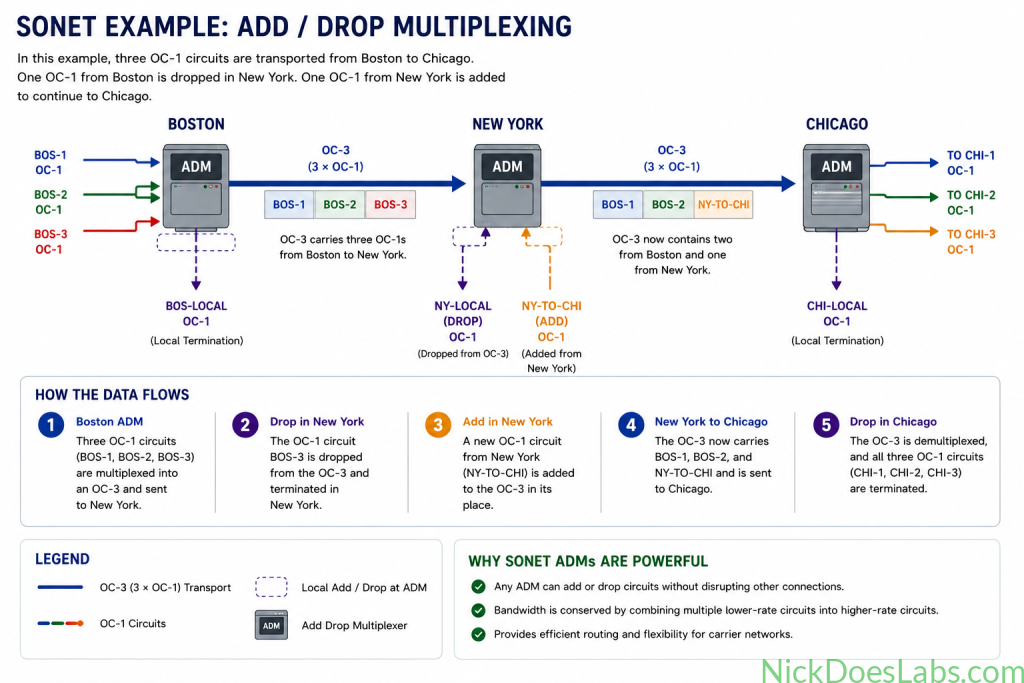
ADMs connect to other ADMs in a topology known as a SONET Ring. The ring topology provides redundancy in the case of a fiber cut. Any ADM in a ring can add or drop containers from the carrier transport circuit. Dropped containers can either be added to another transport circuit or locally terminated on that ADM.
For example, imagine a carrier has ADMs in Boston, New York, and Chicago. Two OC-1s in Boston and an OC-1 in New York all need to go to Chicago. There is another OC-1 in Boston that only needs to go to New York. All three of the OC-1s in Boston will ride on the same OC-3 to New York. In New York, the OC-1 destined for New York will get dropped from the OC-3. Then, the OC-1 from New York bound for Chicago will take its place on the OC-3 going to Chicago along with the two other Boston OC-1s.
As you can see, Add Drop Multiplexers are incredibly efficient at bandwidth conservation and circuit routing. The flexibility in circuit transport made them a staple of carrier networks. SONET and ADMs became the de facto method of transporting T1s and T3s between telecom central offices. In fact, modern ADMs can terminate T-Carriers directly without needing specialized equipment. SONET was the de facto method of providing leased lines to customers before MPLS Pseudowires really took off.
Technical Information
SONET ADMs used Time Division Multiplexing like their T-Carrier predecessors. The SONET frame rate is 125 microseconds or 8,000 times per second. Each STS-1 has a frame around it to identify it. Higher level containers like an OC-12 (12 STS-1s) are just a series of STS-1 frames repeating every 125 microseconds. Using framed STS-1s as the fundamental building block is what allows ADMs to easily add and drop containers. The added bandwidth comes from the fiber optics and laser hardware used, not from timing or formatting.
What are DWDM Multiplexers?
Dense Wavelength Division Multiplexing (DWDM) combines multiple wavelengths onto a single fiber for transport. A wavelength a specific light color that represents a unique stream of data. Multiple colors can exist on the same fiber at the same time. This maximizes the bandwidth potential of fiber optics.
Note: The wavelengths transmitted on a fiber strand are outside the visible light spectrum. Never look directly into a fiber optic strand as this can cause eye damage.
DWDM is a successor to CWDM or Coarse Wavelength Division Multiplexing. The difference is that DWDM features more tightly spaced wavelengths than CWDM which allows for more bandwidth. CWDM supported around 18 wavelengths, with bandwidth ranging from 100 Gbps to 1.8 Tbps. DWDM can support up to 96+ wavelengths with bandwidth maxing around 100 Tbps.
Each wavelength in DWDM has a bandwidth ranging from 100 Gbps to 400 Gbps. The exact bandwidth depends on the hardware being used. Wavelengths are their own private layer 1 channels in the same way that an OC-1 or T1 is a private line.
A whole new multiplexing system was built around the science of DWDM, it is called Optical Transport Networking (OTN).
What is Optical Transport Networking?
OTN is a modern replacement for the SONET/SDH protocols that dominated the early days of fiber optics. OTN is built around DWDM multiplexers with their bandwidth capabilities in mind. Instead of the OC channels that SONET uses, OTN has Optical Transmission Units and Optical Data Units (OTUs and ODUs). OTUs make up point to point transport paths between multiplexers. ODUs ride on top of OTUs and can form end to end tunnels.
OTN Containers and Bandwidths
| OTN Designation | Bandwidth |
|---|---|
| ODU0 | 1.244 Gbps |
| ODU1 | 2.498 Gbps |
| ODU2 | 10.037 Gbps |
| ODU3 | 40.319 Gbps |
| ODU4 | 104.794 Gbps |
| ODUflex | Custom in increments of 1.25 Gbps |
| ODUCn | Custom > 100 Gbps. Increments of 100 Gbps |
The maximum standardized ODU size is the ODU 4 which carries around 104 Gbps payload. However ODUCn allows custom container sizes in 100 Gbps increments. ODUflex allows more flexibility with 1.25 Gbps increments. Either option can scale up to 1+ Tbps. A common payload for an ODU would be 100 Gbps Ethernet Virtual Circuits. OTN can transport other types of lower bandwidth circuits. For example, ODUs can encapsulate and carry SONET or T-Carrier circuits via DWDM. This has made DWDM the de facto standard for modern day carrier transport.
I realize this is all a bit complex, so I asked ChatGPT to help explain it. It gave me the following analogy which I love enough to share verbatim:
Imagine a highway:
- Wavelength = one physical lane on the highway.
- OTU = the truck driving down that lane.
- ODU = the cargo inside the truck.
The lane exists whether or not a truck is using it. The OTU is what actually travels over the lane.
Modern multiplexers generally handle Wavelength assignment automatically. Transport engineers will configure the OTU paths between multiplexers as well as the ODU channels as needed. Customers with the need for very high bandwidth leased lines can lease ODUs / OTUs from service providers. Service providers may also offer “dark wavelength” services where entire wavelengths are reserved for a customer.
The main takeaway here is that OTN and DWDM allows engineers to create much higher bandwidth layer 2 adjacencies between devices than SONET ever did. Because of this, DWDM is the modern standard for carrier transport. For detailed information on OTN from the industry leader, see the Ciena Documentation.
On that note, there is one more thing to discuss….
What is a ROADM?
In the early days of DWDM there were Optical Add Drop Multiplexers (OADMs). OADMs were similar to SONET ADMs in that they could add or drop channels at each node. The difference was that OADM channels were light wavelengths instead of SONET containers. Early OADM configurations were based in wiring and hardware. This meant that if engineers needed to change an OADM config (e.g add wavelength x in Boston) a technician would need to alter the hardware.
The Reconfigurable Optical Add Drop Multiplexer (ROADM) improved efficiency and cost savings by allowing configurations to be changed remotely in software. ROADMs use a Wavelength Selective Switch to add/drop or pass through wavelengths. Modern WSS’s are fully flexible allowing for different channel sizes for each wavelength. They are also fully dynamic and can add/drop/redirect wavelengths with ease. This allows for easier provisioning / deprovisioning as well as service restoral operations. The market leader in ROADM manufacturing is Ciena and their 6500 Series. These modern ROADMs are packet optical platforms meaning that they can also perform certain PE router functions as well. The ability to terminate subscriber services such as a Layer 2 MPLS VPN as well as transport it across a provider core allows for more efficient operations.
These days almost all OADMs used in production are ROADMs. For more information on ROADMs see the Ciena documentation.
Conclusion
The future of Optical Networking is bright (pun intended). We have reviewed SONET, Add Drop Multiplexers, DWDM, OTN, and ROADMs in this article. These technologies have helped greatly to maximize the bandwidth potential of fiber optics. They have allowed service providers to run leaner and more efficient operations with less equipment and less labor required. Most importantly, they have contributed to the rising bandwidth levels available to us consumers. Things like online gaming and streaming owe much thanks to these technologies that make multi-gig home internet speeds possible.